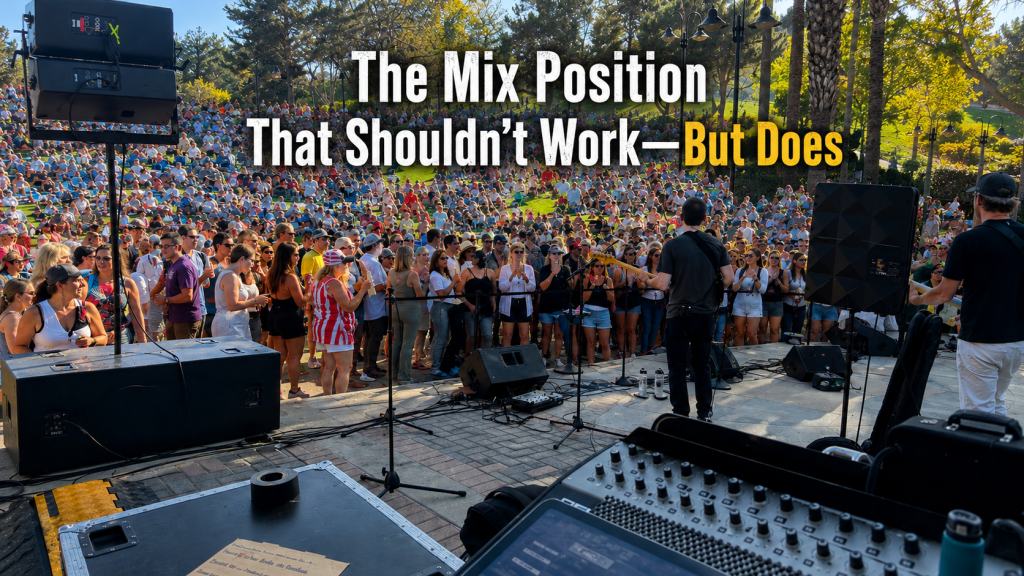
Every live sound engineer learns the “correct” location for a front-of-house mix position. Ideally, the console sits centered between the left and right main loudspeakers and roughly two-thirds of the way back in the audience. From there, the engineer hears almost exactly what the audience hears, making it possible to make confident decisions about balance, EQ, dynamics, effects, and overall tonal character. In theory, that’s where every mix should happen.
The problem is… we don’t work in theory.
In the real world, I don’t always have the luxury of an optimal mix position. I often find myself running sound from behind the main PA.
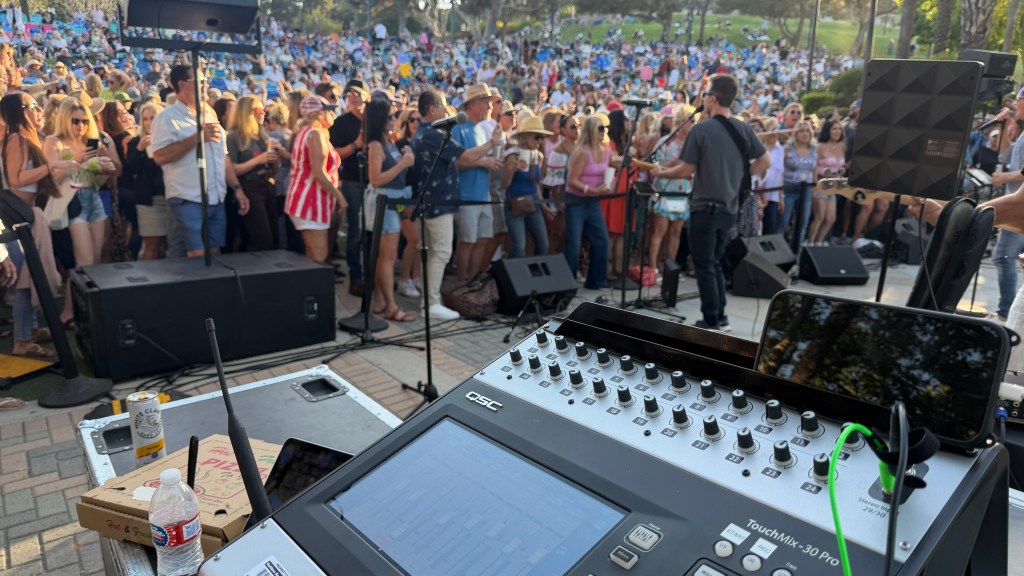
You might be thinking, Why in the world would anyone even attempt that? Seriously? You can’t hear what the audience is hearing.
And you’re absolutely right.
You can’t.
But live production is full of compromises, and one of the most valuable skills an audio engineer can develop is the ability to adapt. Sometimes a client simply doesn’t want a front-of-house footprint because it interferes with the aesthetics of the event. Other times there just isn’t a practical location for a console without sacrificing valuable audience space.
This summer I’ve been serving as the A1 for the City of Aliso Viejo’s summer concert series. The concerts take place in a beautiful amphitheater-style park where families arrive hours early to spread blankets across the hillside and claim their favorite viewing spots. By the time we arrive, that audience area belongs to them.
The city has one request: keep the space in front of the main loudspeakers open for the audience.
That means no front-of-house mix position.
If there’s one thing I’ve learned as a freelance audio engineer, it’s this:
The client gets what the client wants.
It’s my job to figure out how to make the show sound exceptional—even when I can’t mix from the place every audio textbook says I should be standing.
Fortunately, there’s a workflow that makes it possible.
Step One: Build a Rock-Solid Foundation
The success of this approach begins during soundcheck.
First, I establish proper input gains for every microphone and instrument. Good gain structure is the foundation of every great mix. When every input arrives at the console with healthy, consistent signal levels, compressors behave predictably, EQ adjustments remain effective, and every fader has plenty of usable travel. If the foundation isn’t solid, everything that follows becomes much more difficult.
Step Two: Build the Mix Where the Audience Will Listen
Next, I grab my iPad, which is wirelessly connected to the console, and walk out to the ideal listening position in front of the PA.
This is where I build the show.
As the band plays I establish EQ, dynamics, effects, stereo placement, and, most importantly, the balance between every instrument and vocal. I spend extra time making sure the lead vocal sits exactly where it should and that every musical element has its own place in the mix.
This step is critical.
Before I ever return to my console, I want the house mix to sound exactly the way I want the audience to hear it.
Only then do I move to the next phase.
Step Three: Build My Personal Reference Mix
Using the same song I mixed out in front of the PA, I return to my console, put on my in-ear monitors, and create a completely separate stereo mix for myself using a dedicated stereo bus set to post-fader.
A post-fader bus simply means that any movement I make on the main mix faders is automatically reflected in my in-ear reference mix. If I raise the lead vocal in the house, it also comes up in my ears. If I pull back the guitars, I hear that change immediately.
As I build this in-ear mix, I’m relying on my auditory memory of what I just heard from the audience perspective. I’m essentially translating the front-of-house mix into a reference that works inside my ears.
Once the two mixes closely match, I’m ready for the show.
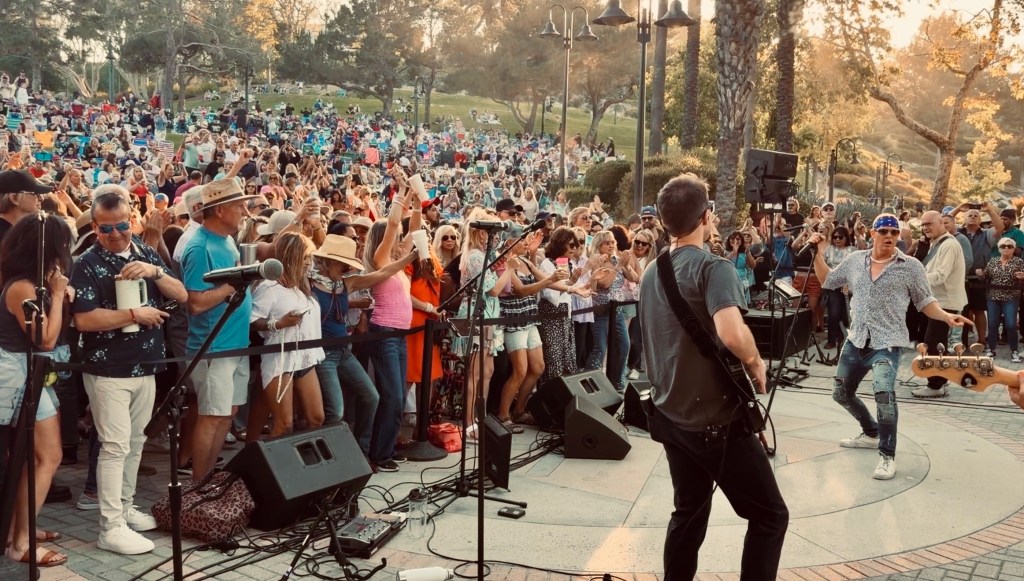
During the performance, I cue my dedicated stereo reference bus in my in-ear monitors while continuing to mix on the main LR faders. Because the reference bus follows every fader move, I always know how my adjustments are affecting the house mix—even though I’m physically standing behind the PA.
One Unexpected Advantage
There’s actually one feature my in-ear reference has that the audience mix doesn’t.
Stereo panning.
Inside my in-ear mix I can spread instruments across the stereo field much more aggressively than I would in the house. That separation allows me to identify individual instruments almost instantly.
For example, when a guitar solo starts, I don’t have to hunt for it.
My ears already know exactly where it lives.
That makes reacting to the performance incredibly fast, especially during busy arrangements where several instruments occupy similar frequencies.
The Right In-Ear Monitors Matter
Not all in-ear monitors are created equal.
For this workflow, isolation is everything.
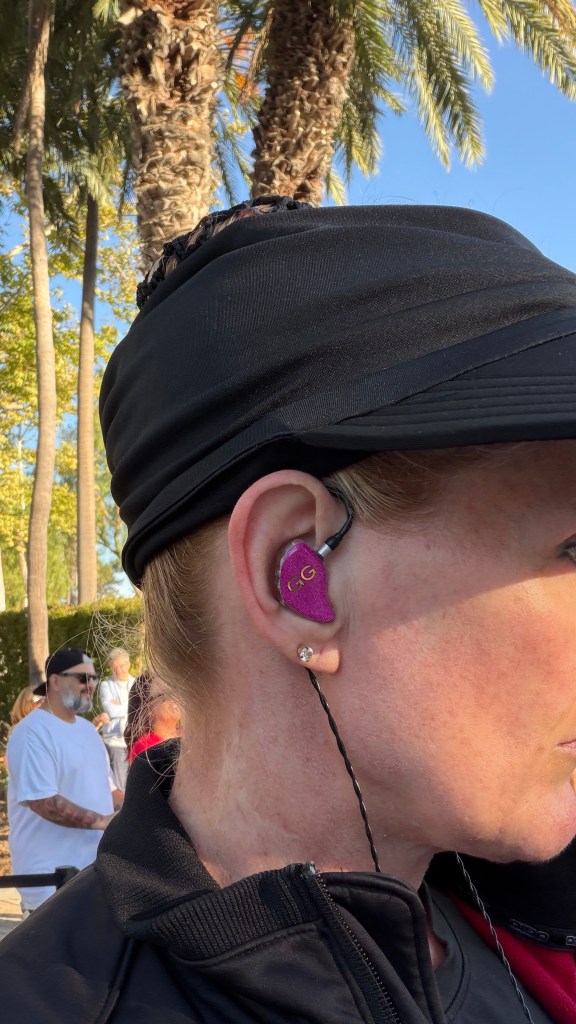
Custom-molded in-ear monitors dramatically reduce stage wash, wedge monitors, crowd noise, and everything else competing with my reference mix. The cleaner my reference is, the more confidently I can make mix decisions.
I’ve been using UE Live custom in-ear monitors from Ultimate Ears, and they’ve been outstanding. Their isolation, comfort, and sonic accuracy make them an ideal tool for this style of mixing.
Final Thoughts
Would I choose to mix from behind the main PA if I had a perfect venue with unlimited space?
Of course not.
Nothing replaces standing in the audience and hearing exactly what they’re hearing.
But live production isn’t about waiting for perfect conditions—it’s about delivering exceptional results with the conditions you’ve been given.
Some of the best engineering happens when we’re forced to adapt. Every unusual venue, every impossible stage layout, and every client request challenges us to become more creative, more resourceful, and ultimately better engineers.
Sometimes the best mix position isn’t the one you wanted.
It’s simply the one you have.
And if you’re prepared, that can be more than enough.

 Soundcheck Diaries
Leave a comment