You don’t have to be a sound engineer to be a great musician. But knowing a little about sound can take you a long way.
Long before I made my living as a sound engineer, I was a full-time musician.
My husband, Michael, and I spent years traveling around the country sharing our music, primarily in the Christian music world and at outreach events. We performed in all kinds of venues, from well-equipped facilities to places where the sound system was little more than a mixer and a couple of speakers to places where we had to provide our own sound system.

And here’s something we learned pretty quickly: Just because a venue has a sound system doesn’t mean it has someone who knows how to operate it.
Sometimes we had a knowledgeable sound engineer. Other times, we had a well-meaning volunteer who knew very little about audio. And sometimes, there was no sound person at all.
That’s when my understanding of audio fundamentals became just as important as my ability to play the piano, guitar and sing.
I learned to bring my own mixer, build a great-sounding submix of our instruments and vocals, and send that mix to the house PA. It meant I could maintain control over our sound regardless of who was operating the venue’s system.
Was it always ideal? Of course not. But it worked.
And looking back, I can say with confidence that without that knowledge, we probably wouldn’t have been able to perform in half the places we did.
That experience taught me something I’ve carried throughout my career, both as a musician and as a sound engineer:
You don’t have to become an audio engineer. But the more you understand about sound, the more opportunities you’ll have to make music.
Here are eight reasons why I believe every musician, including vocalists, should learn at least the fundamentals of audio.
1. You’ll Know How to Communicate With Your Sound Engineer
One of the biggest challenges during soundcheck is when musicians struggle to explain what they’re hearing.
I was working with a band whose lead singer didn’t have much experience with professional sound systems. During soundcheck, he kept asking for more instruments in his floor monitor. More guitar, more keyboards, more of this, more of that.
Eventually, he announced, “I can’t hear my voice!”
I looked at my mixer and noticed I was already sending plenty of his vocal to the wedge. So I walked up to the stage to listen for myself.
The problem wasn’t that his vocal was too quiet. It was that everything else was too loud!
I pulled back the competing instruments while keeping enough for his musical reference. Suddenly, his voice popped right out of the mix.
I hadn’t turned his vocal up. I’d made room for it.
This is a basic principle of mixing called masking, where competing sounds make it difficult to distinguish what you want to hear.
Had this singer understood that concept, he might have said, “Can we bring the instruments down a little? They’re covering up my vocal.”
That’s a much more useful request than simply asking for more volume.
The takeaway: Understanding basic audio concepts helps you communicate what you’re hearing and what needs to change. Better communication means faster soundchecks, better monitor mixes, and less frustration for everyone.
2. You’ll Understand Why Stage Volume Matters
Just because your instrument sounds great onstage doesn’t necessarily mean it sounds great to the audience.
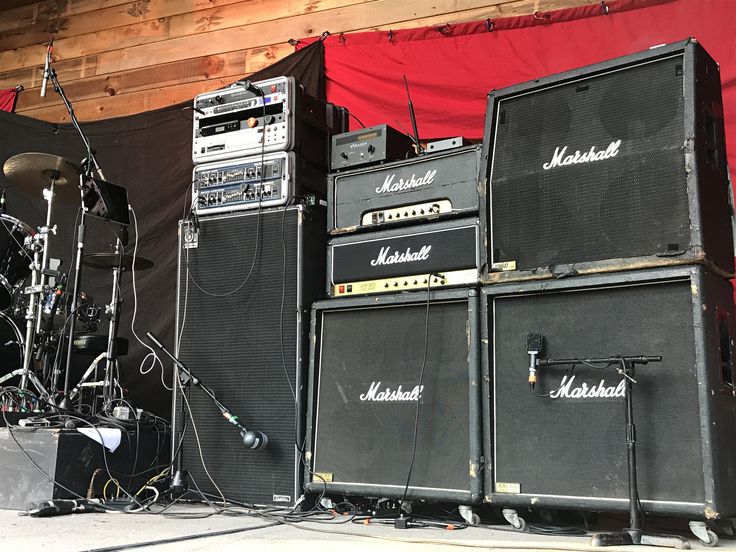
I once had a rock band come into our midsized venue with their guitar amplifiers absolutely blazing! Standing next to their amps, the guitar players probably thought their tone sounded incredible. But out in the audience, it was a completely different story.
The amplifiers were so loud that I couldn’t even reinforce the guitars through the PA without making the entire concert painfully loud. And when the stage volume is already overwhelming the room, there’s very little a sound engineer can do to create a balanced mix.
So here’s what we did.
I asked the drummer to play acoustically, without any reinforcement through the PA. Then we adjusted the guitar and bass amplifiers until everything was reasonably balanced with the natural volume of the drums.
Suddenly, I had control of the mix again! I could bring the instruments into the PA, balance them with the vocals, and actually mix the band instead of fighting the stage volume.
And you know what? The concert sounded amazing!
Your Amplifier Is Part of the Room, Too!
Here’s something many musicians don’t consider: Your amplifier isn’t just part of a larger sound system. It’s also part of the room’s acoustics.
The sound coming from your amplifier doesn’t stop at your ears. It travels throughout the venue, reflects off walls, ceilings, and other surfaces, and interacts with the sound coming from every other instrument and the PA system.
That incredible guitar tone you dialed in while standing a few feet from your amplifier might sound completely different to someone sitting 30 feet away.
And in a midsized room, where the audience is relatively close to the stage, excessive amplifier volume can quickly overpower the entire mix.
This is why understanding stage volume is so important. It’s not about sacrificing your tone or turning everything down until the band loses its energy. It’s about finding the right balance between the instruments, the room, and the PA system.
The takeaway: Great sound doesn’t begin at the mixing console. It begins onstage. When musicians understand how their instruments interact with the room and the larger sound system, they become part of the solution rather than another challenge for the sound engineer.
And ultimately, everyone wins: the musicians, the engineer, and most importantly, the audience.
3. You’ll Be Able to Troubleshoot Your Own Equipment
Equipment problems have a way of showing up at the worst possible time, like 5 minutes before showtime. And knowing how to troubleshoot them can be the difference between a quick fix and a frustrating delay.
One example I encounter regularly involves guitarists with elaborate pedalboards.
A guitarist strums a chord. Nothing.
They check their amp, check their guitar, and start pushing buttons on their pedals.
Still nothing.
“I’m not getting any sound!”
This is where understanding one of the most important audio fundamentals, signal flow, becomes invaluable.
Every audio signal follows a path. In this case, it travels from the guitar through a series of pedals and cables before reaching an amplifier or sound system.
If the signal disappears, the solution is to follow that path and determine where it stops.
Often, the culprit is something simple, like a faulty patch cable, a loose connection, or a pedal that isn’t passing signal.
But when musicians don’t understand signal flow, guess who gets called over?
The sound engineer.
Now I’m leaving my position at front of house to troubleshoot a problem the musician could potentially have solved themselves, while other microphones, monitor mixes, and soundcheck responsibilities are waiting for my attention.
A little knowledge of signal flow can turn a frustrating mystery into a simple process of elimination.
I’ve actually written an entire article about this: The Guitar Is Plugged In… So Where’s the Signal?. It’s a step-by-step troubleshooting guide for guitar players using pedals.
And this principle applies to everyone, whether you play guitar, keyboards, bass, or any instrument that connects to a sound system.
The takeaway: Understanding signal flow gives you the ability to troubleshoot your own equipment, solve problems faster, and keep soundcheck moving. You don’t need to be a technician. You just need to understand how your signal gets from point A to point B.
4. You’ll Understand How Microphone Technique Affects Your Sound
I’ve worked with some incredibly talented singers who don’t always realize how much their microphone technique affects what the audience hears.
One habit I see frequently, especially with jazz singers, is pulling way off the microphone while singing. Maybe it’s for dramatic effect, or maybe they just think it looks cool.
In a small, intimate room, they might get away with it. But in a larger venue, it’s a different story.
As they move away from the microphone, their vocal level drops dramatically. The people near the stage might still hear them acoustically, but the audience farther back can lose much of what they’re singing.
And turning up the microphone isn’t always an option because doing so also increases unwanted stage sound and the risk of feedback.
The Livestream Has No Ears in the Room
Here’s where microphone technique becomes even more critical.
When I’m mixing a livestream, the microphones are essentially the ears of the online audience.
Someone watching from home doesn’t hear the singer’s natural voice traveling through the room. They hear what the microphone captures.
So when a singer dramatically pulls away from the mic, they might think they’re delivering a beautifully expressive moment.
But on the livestream?
They’ve practically disappeared!
No amount of clever mixing can fully recover a voice the microphone isn’t picking up.
And Then There’s the Feedback Problem
Another habit I encounter often is the singer who finishes a phrase and casually drops their hand, microphone and all, down by their side.
Seems harmless enough, right?
Except now the microphone capsule is pointing directly into a loud floor monitor.
And you can probably guess what happens next.
FEEDBACK!
Microphones have pickup patterns that determine which directions they’re most sensitive to. When a singer points the microphone toward a loudspeaker, they can create an acoustic feedback loop.
Understanding microphone direction, distance, and gain before feedback helps singers avoid these problems before they happen.
The takeaway: Your microphone is the connection between your voice and your audience. Understanding how microphone positioning affects sound helps you deliver a more consistent performance, avoid feedback, and make sure your audience hears every note, whether they’re in the front row or watching from home.
5. You’ll Get Better Monitor Mixes
One of the great things about modern sound systems is the ability to give musicians control over their own in-ear monitor mixes. I frequently set musicians up with iPads so they can adjust their own stereo mixes right from the stage.
Sounds great, right?
Well, that depends on whether they understand a few basic mixing concepts.
I’ve watched musicians build their mixes by turning everything up. More vocals, more guitars, more keyboards, more drums. Before long, everything is competing for attention, and they’ve created one giant wall of sound right in the center of their stereo mix.
Now they’re struggling to distinguish their own instrument or vocal from everything else.
And what do they do?
Turn it up some more! Ouch!
That’s usually when I step in and introduce them to one of the simplest and most useful mixing tools: the pan control.
I explain how panning allows us to position instruments across the stereo field rather than stacking everything in the center. By spreading certain instruments left and right, we create separation, making individual parts easier to distinguish.
Suddenly, they can hear their instrument or vocal more clearly without having to crank everything up.
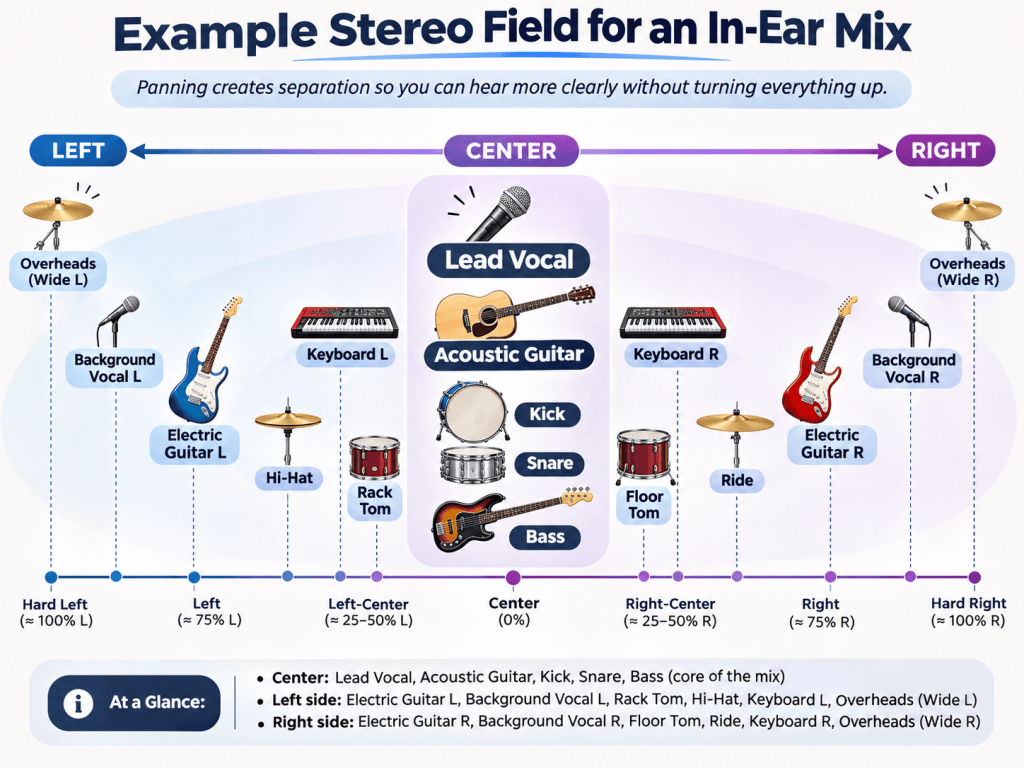
And just as importantly, we can often bring the overall listening level down.
Another concept I teach is that not everything needs to be equally loud in your ears. Some instruments are essential for timing, pitch, or musical cues. Others might only need to be present enough to provide a little reference.
A great monitor mix isn’t about hearing more of everything. It’s about clearly hearing what you need.
And even if you’re not controlling your own mix, understanding these concepts helps you communicate more effectively with your front-of-house or monitor engineer. Instead of constantly asking for more volume, you might request a little separation between instruments or ask to turn down something that’s competing with what you really need to hear.
The takeaway: Understanding basic mixing concepts like panning, balance, and stereo imaging allows you to create clearer, more useful in-ear monitor mixes. You’ll hear what matters, make better decisions about what you need, and potentially listen at safer volume levels.
6. You’ll Understand Why Your Instrument Sounds Different Through the PA
I’ve worked with plenty of bass players who have spent a lot of time dialing in the perfect sound on their amplifiers.
And that’s great! Until that sound doesn’t translate very well through the house PA.
Here’s a situation I encounter pretty regularly.
A bass player asks me to take a direct signal from their amplifier, specifically the post-EQ output. That means whatever EQ settings they’ve dialed into their amp are also being sent to my mixing console.
Sounds reasonable, right?
Except sometimes I look at their amplifier and discover they’ve cranked the bass way up while turning the higher frequencies way down.
The result through the PA?
THUD. THUD. THUD.
Lots of low end, but almost no definition.
The audience can feel the bass, but they can barely distinguish what the bass player is actually playing!
Here’s the audio fundamental these musicians are missing: A sound system can only reproduce the signal it’s being given.
A bass guitar produces much more than low frequencies. The upper frequencies contain important details, including string attack, fret noise, and the articulation that helps us distinguish individual notes.
When those frequencies are dramatically reduced at the amplifier, they may not be available in sufficient amounts for me to work with at the mixing console.
I can try boosting the highs with EQ, but I can’t magically restore detail that’s been severely filtered out of the signal.
So what do I do?
I walk up to the stage, explain what I’m hearing through the PA, and show the bass player what needs to change.
Most of the time, they’re happy to let me make a few adjustments right there on their amplifier.
And suddenly, instead of a low-frequency rumble, we have a bass guitar that actually sounds like a bass guitar!
The low end is still there, but now there’s definition, articulation, and enough clarity for the instrument to sit properly in the mix.
The sound that works standing next to your amplifier isn’t necessarily the sound that works through a PA.
Understanding basic EQ and frequency response helps musicians recognize that their instrument is part of a much larger sound system. What sounds great onstage may need some adjustment to translate properly to the audience.
The takeaway: Learning how EQ and frequency response affect your instrument helps you make better tonal decisions before your signal ever reaches the mixing console. When you understand what frequencies contribute to your instrument’s character, you can work with your sound engineer to deliver a sound that’s not just powerful, but clear, defined, and musical.
7. You’ll Become a More Valuable, Professional Musician
Some of my favorite bands to work with aren’t necessarily the ones with the fanciest equipment. They’re the ones who show up prepared, understand their sound systems, and know how to work as a team.
Three bands immediately come to mind: Turn the Page, a Bob Seger tribute band, Ronstadt Revival, and a local favorite, Tijuana Dogs.
What makes these bands such a breath of fresh air is that each has a musician in the band who also serves as their sound engineer.
They arrive with their own signal splits and mixing consoles, ready to handle their own in-ear monitor mixes and, when needed, floor wedges.
These musicians understand the big picture. They know their equipment, understand signal flow, and have already done the preparation necessary to make everything work.
And as the front-of-house engineer, I absolutely love it!
Instead of spending soundcheck troubleshooting equipment and building monitor mixes, I can concentrate on what I was hired to do: deliver a stellar mix for the audience.
Now, I’m certainly not suggesting every musician needs to become a self-sufficient sound engineer or bring their own mixing console to a gig.
But here’s the point.
Musicians who understand audio fundamentals are easier to work with because they can be part of the solution instead of depending on someone else to solve every problem.
Even a basic understanding of signal flow, gain structure, EQ, and monitor mixing makes a difference. When something isn’t working, we can communicate, troubleshoot, and solve problems together.
And that kind of professionalism doesn’t go unnoticed.
The takeaway: Being a great musician goes beyond playing your instrument well. Understanding audio fundamentals makes you more prepared, more adaptable, and a more valuable member of any band. When you make everyone’s job easier, you’re the kind of musician people look forward to working with again.
8. Audio Knowledge Gives You Independence and Opens Doors to More Gigs
When my husband, Michael, and I were traveling around the country performing at churches and outreach events, we learned pretty quickly that not every venue had a great sound system, or even someone who knew how to operate it.
But here’s the thing.
We never felt limited by what a venue couldn’t provide because I knew how to provide what was missing.
Whether that meant bringing our own equipment, setting up a sound system, or creating our own mix, I had the knowledge to make it work.
And that opened doors to perform at places we might otherwise have had to turn down.
I think this is especially important for solo artists and musicians just starting their careers.
Imagine being able to show up at a coffee shop, private event, church, or small venue and confidently set up your own sound system, connect your instruments and microphones, and deliver a great-sounding performance without depending on someone else to make it happen.
The more you can do for yourself, the more opportunities you can create for yourself.
I have a substitute engineer at Campus JAX, Jim, who is a perfect example of this. He’s also a solo performer with a one-man show. He provides his own sound system, handles his own audio, and performs at all kinds of events.

And when he’s not performing, he’s also earning income working as a sound engineer, including filling in for me at Campus JAX.
Sound familiar?
That’s essentially how my own career evolved. What started as learning enough about audio to support my music eventually became an entirely separate income stream.
Now I get paid to do something I originally learned because I wanted to make my own performances sound better!
Of course, not every musician needs to become a professional sound engineer. But understanding the fundamentals gives you options you might never have considered.
The takeaway: Audio knowledge gives you more than control over your sound. It gives you independence, confidence, and the ability to say yes to opportunities that might otherwise be out of reach. And who knows? What starts as a skill to support your music could eventually become another way to earn a living doing something you love.
Before You Go… I Want to Let You In on a Little Secret!
I’ve been working on something behind the scenes that I’m really excited about.
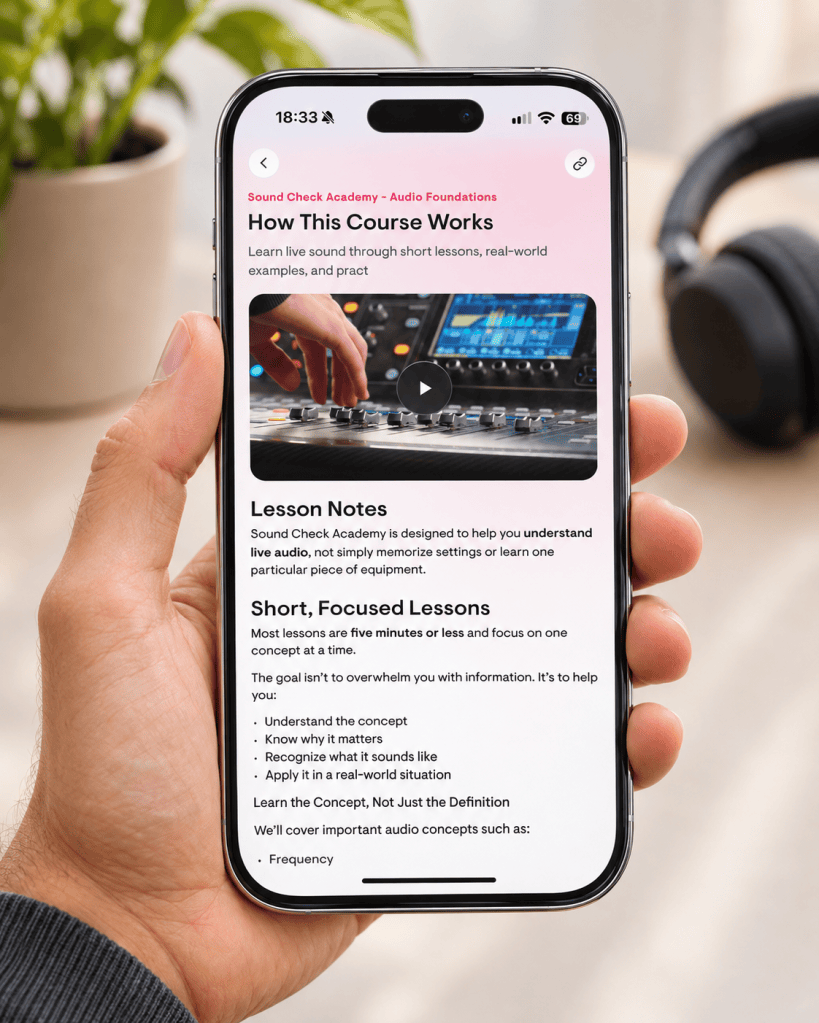
It’s called Sound Check Academy, and it’s an online audio training course I’m developing to help musicians and aspiring sound engineers understand the fundamentals of live sound.
Over the years, I’ve discovered that some of the most valuable audio lessons aren’t necessarily the most complicated ones. They’re the fundamentals that help you make better decisions, solve problems, and ultimately sound better.
And that’s exactly what I want to teach.
Whether you’re a musician running your own sound, a church volunteer behind a mixing console, or someone interested in becoming a professional sound engineer, Sound Check Academy is being designed with you in mind.
The course will feature short, easy-to-follow lessons that break down audio concepts into plain English. We’ll cover things like signal flow, gain structure, EQ, compression, microphone techniques, monitor mixing, and much more.
No complicated engineering degree required. Just practical knowledge you can put to work at your very next gig.
And because I believe some of the best lessons come from real-world experiences, I’ll be sharing plenty of stories, demonstrations, and practical solutions from my years behind the mixing console and as a musician providing sound for myself.
My goal is simple: To take the mystery out of audio and give you the knowledge and confidence to make great sound.
Sound Check Academy is still in development, but I can’t wait to share it with you!
In the meantime, subscribe to Soundcheck Diaries so you won’t miss the official announcement, course updates, and more real-world audio stories and tips.
Because the better you understand sound, the better your music can sound.
See you at soundcheck!





Leave a Reply