Tuesday Night at JAX Songstage
Tuesday nights at Campus JAX are especially fun and entertaining. It’s JAX Songstage—a night devoted to songwriting, original music, and the inventive and creative artists who bring those songs to life.
And you never quite know what you’re going to get.
No bands allowed. It’s just the artists and their instruments, sharing their stories and the songs they’ve written. They make us laugh. They make us cry. Some songs are provocative and thought-provoking. Others are downright silly. But no matter the tone, every song is heartfelt, and most come from personal experience.
The show is presented as a Nashville Round. Five or six songwriters sit together onstage, and rather than one artist performing a complete set, they take turns. The first artist plays a song, then the next artist plays one, and we continue down the line until everyone has performed. Then we circle back to the first artist and begin another round. By the end of the night, we’ve heard several songs from each songwriter—and usually quite a few stories along the way.
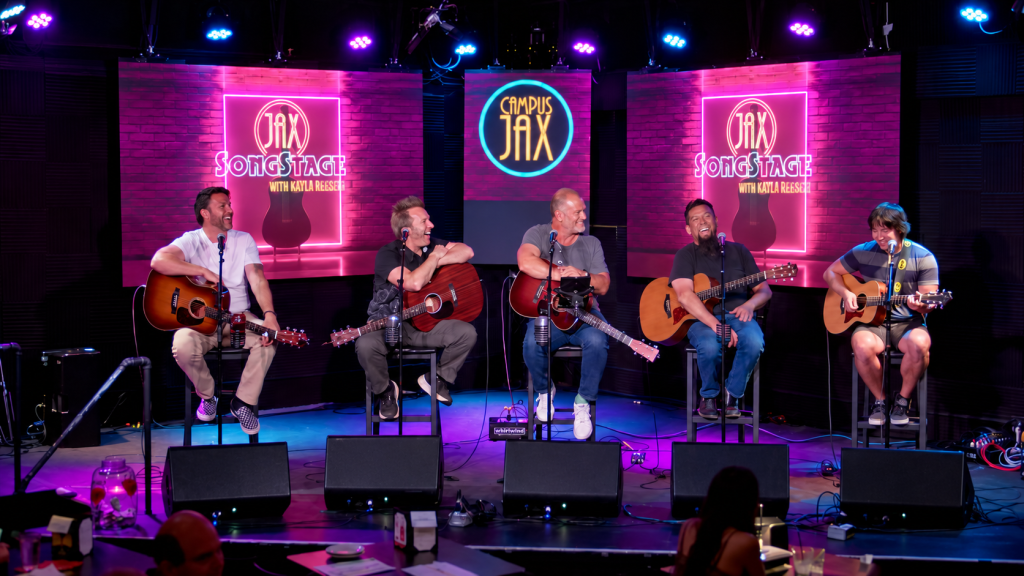
From the mix position, you might look at that stage and think, Five acoustic guitars. Five vocals. Only one artist performing at a time. This should be an easy night.
Think again.
Five Acoustic Guitars, Five Completely Different Sounds
Put five acoustic guitars onstage and you can end up with five wildly different sounds coming into the console. The guitar itself matters—its body, construction, strings, and natural tonal character—but that’s only the beginning. Most of these guitars have built-in pickups, and those pickup systems can sound dramatically different from one another. One might arrive at the console warm and full, another thin and bright, another boomy in the low mids, and another with that unmistakable piezo “quack.” Add in onboard preamps and EQ, different DIs, fresh or aging strings, and each player’s individual picking or strumming style, and there is no such thing as one EQ setting that works for every acoustic guitar.
And every once in a while, someone arrives with an acoustic guitar that doesn’t have a pickup at all. In that case, I’m putting a microphone on the guitar, which introduces an entirely different set of tonal characteristics—and a few additional challenges—into the mix.
So while the instruments sitting across the stage may all say “acoustic guitar” on my input list, what reaches my console can be very different from one channel to the next.
And that leads to one of the most important things I’ve learned about EQ:
You don’t EQ an acoustic guitar. You EQ this acoustic guitar.
There isn’t a magic acoustic-guitar EQ curve I can copy and paste across all five channels. I have to listen to each guitar and figure out what this one needs. Is it too boomy? Too thin? Harsh? Boxy? Does the pickup have that telltale piezo quack? Is there one particular frequency jumping out, or does the overall tonal balance need a broader adjustment?
That’s when I reach for one of the most useful tools in my EQ toolbox: the parametric EQ, or PEQ.
Three Controls, Three Questions
A parametric EQ can look intimidating, especially if you’re new to mixing. There are curves, numbers, knobs and terminology that can make something fairly simple seem unnecessarily complicated. But when I’m actually mixing, I’m really using the PEQ to answer three questions:
What frequency do I want to change?
That’s frequency.
How much do I want to change it?
That’s gain.
How much of the area around that frequency do I want to affect?
That’s Q, or bandwidth.
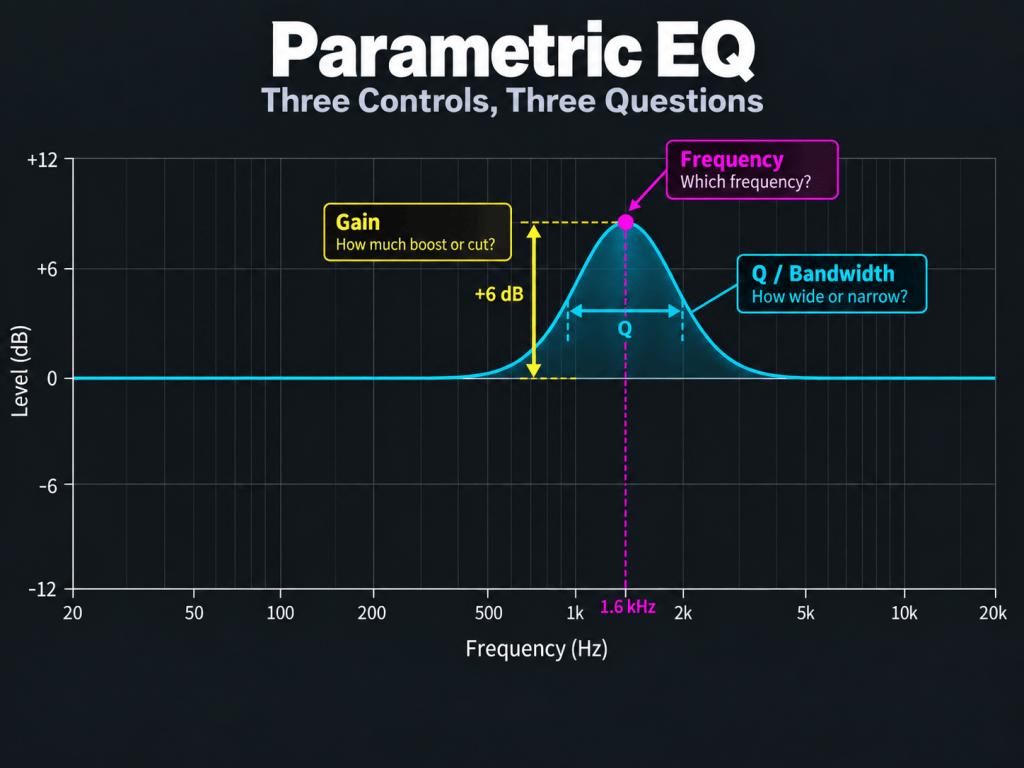
Once you start thinking about parametric EQ in those terms, it becomes much less about manipulating a graph on a screen and much more about what it really is: a tool for shaping what you hear.
Ready, Set…
Before I called the artists to the stage for soundcheck, I already had the high-pass filters (HPFs) engaged on the guitar channels. The lowest string on a standard-tuned acoustic guitar is E2, with a fundamental frequency of about 82 Hz, so I use roughly 80 Hz as my starting point for the HPF. From there, I listen and adjust as needed. The goal is to clean up unnecessary low-frequency rumble and stage noise while still preserving the fullness of the guitar.
If that same acoustic guitar were playing with a full band, I would often move the HPF higher to make room for instruments like the bass and kick drum. But in a Nashville Round, where the acoustic guitar is often carrying the entire accompaniment by itself, I want to preserve more of its low end.
For more on this incredibly useful filter, see my post, The HPF: Your Fastest Path to Clarity.
Go!
I called the artists to the stage and had everyone plug in their guitars. The first thing I do is set the input gain. I ask each player to strum with the fullest dynamic they expect to use during the show. While the channel is muted, I bring up the input gain until the signal is sitting at a healthy level with plenty of headroom.
Then comes the moment of truth.
I unmute the channel and finally get to hear what that guitar is actually giving me.
Guitar 1
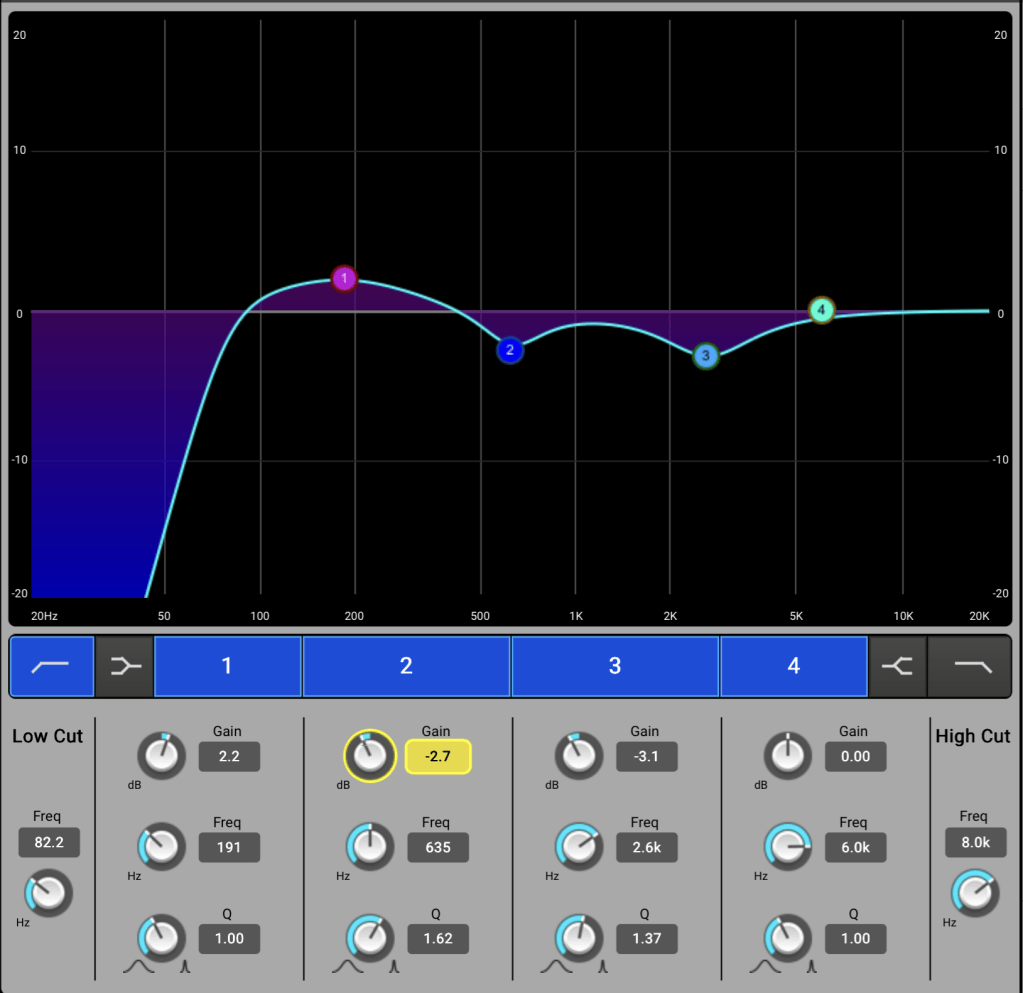
Once I unmuted the first guitar, I listened to what it was actually giving me. I had already set the HPF at about 82 Hz to clean up unnecessary low-frequency rumble while keeping the fullness I wanted from a solo acoustic guitar.
From there, I added a gentle boost around 190 Hz to bring in a little warmth and body. I made a small cut around 635 Hz to reduce some boxiness, then another cut around 2.6 kHz to smooth out some of the harder, more nasal character of the pickup.
Notice that the Q settings are fairly broad. I wasn’t hunting down one tiny resonance; I was shaping the overall tone of the guitar. And that was all it needed.
This wasn’t an “acoustic guitar EQ preset.” It was simply what this guitar needed.
Guitar 2
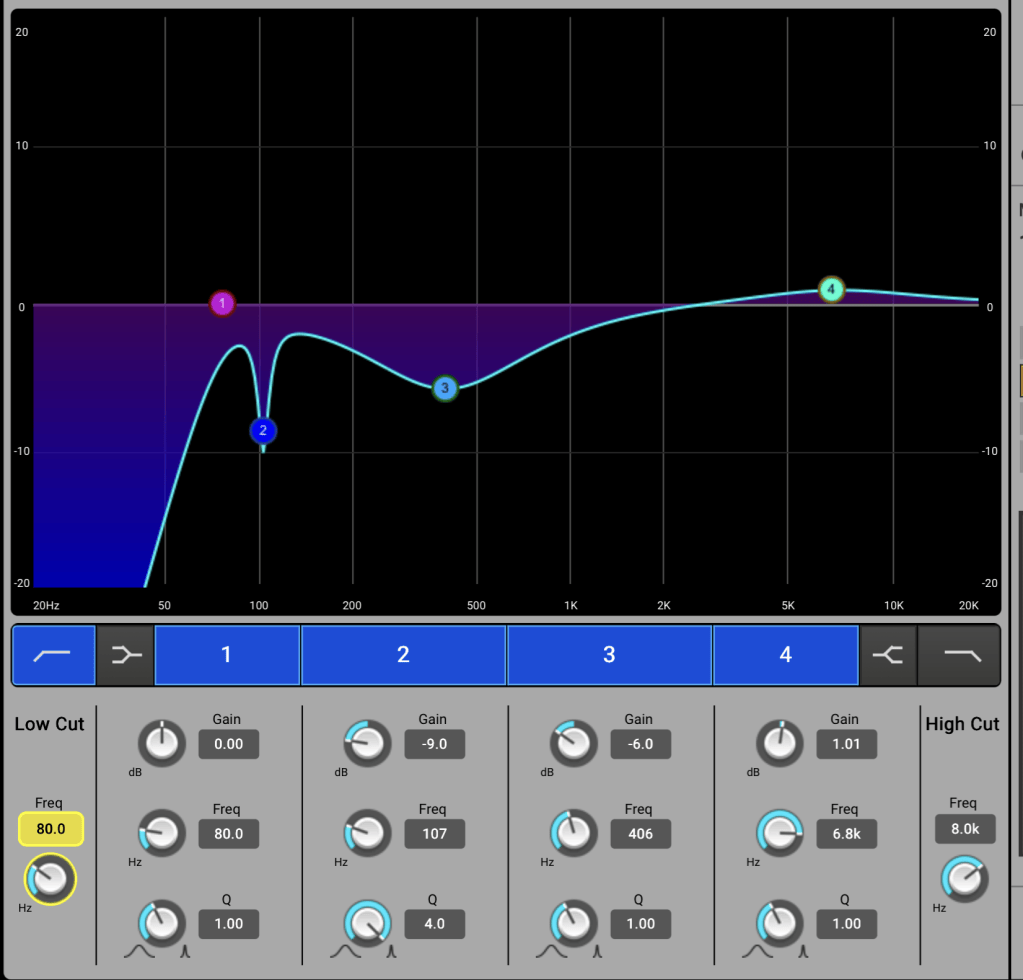
Guitar 2 needed a very different approach. I still started with the HPF at about 80 Hz, but this guitar had much more buildup in the low and low-mid range than Guitar 1.
The biggest move was a fairly narrow cut of 9 dB at 107 Hz. That told me there was a strong low-frequency resonance happening there—too much boom or woofiness for this setting. I followed that with a broader 6 dB cut around 406 Hz to pull out some of the boxy, cloudy character and help the guitar open up.
Once those problem areas were under control, I added a slight boost of about 1 dB at 6.8 kHz to bring back a little presence and articulation.
This guitar needed more corrective EQ than Guitar 1. That’s exactly the point: even when the instruments look the same on stage, what they need in the PA can be completely different.
Guitar 3
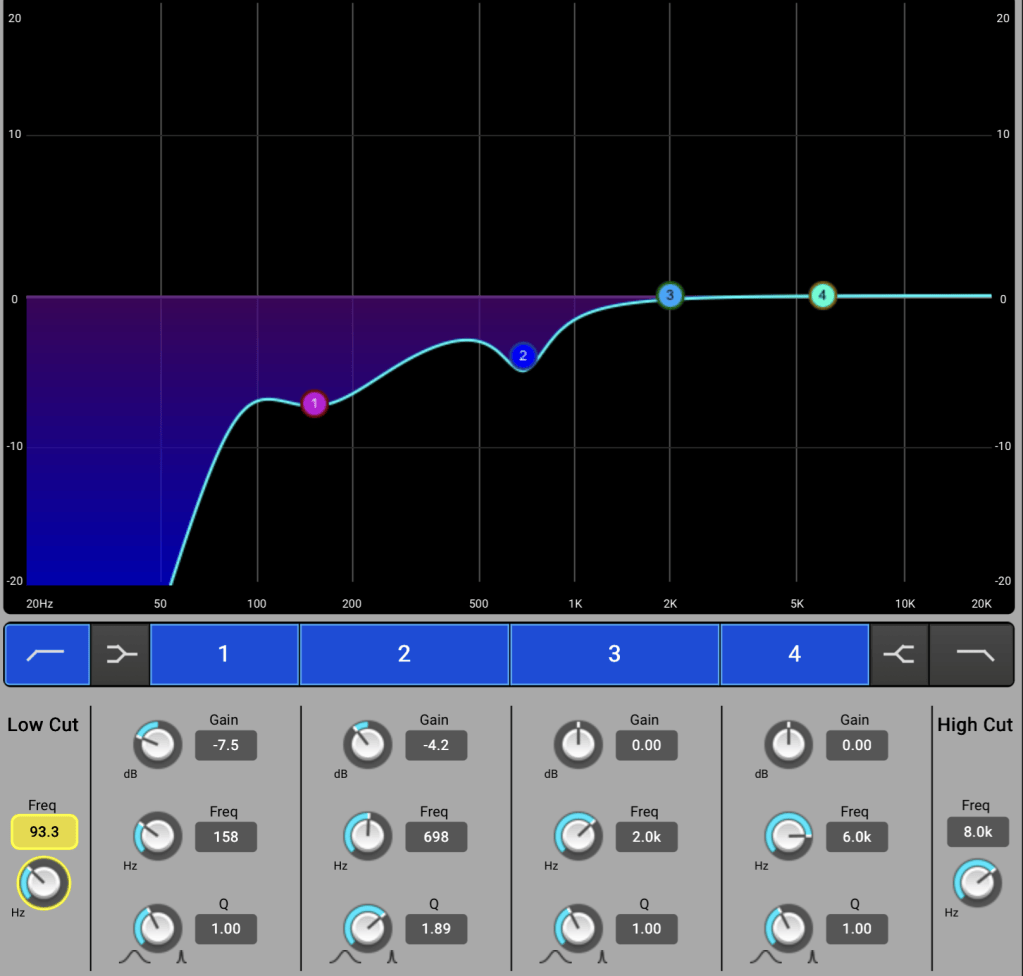
Guitar 3 came in very muddy, and this one needed much more low-end cleanup. It’s possible the bass control on the guitar’s onboard preamp was boosted, but whatever the cause, there was simply too much low-frequency energy reaching the console.
I moved the HPF up slightly to about 93 Hz, then made a broad 7.5 dB cut around 158 Hz. That was the biggest problem area and removing it immediately helped clear out the boom and excessive warmth.
I also made a smaller cut of about 4 dB around 700 Hz with a somewhat narrower Q. That helped reduce some additional boxiness and congestion in the midrange.
I didn’t add anything on the top end. This guitar didn’t need more brightness or presence—it needed subtraction. Once I cleared away the frequencies that were masking the natural character of the instrument, the guitar sounded much more balanced.
This is a good example of why I don’t approach EQ with a rule that says I always have to boost or always have to cut. I listen to what the guitar is giving me and take the shortest route to what I want to hear.
Guitar 4
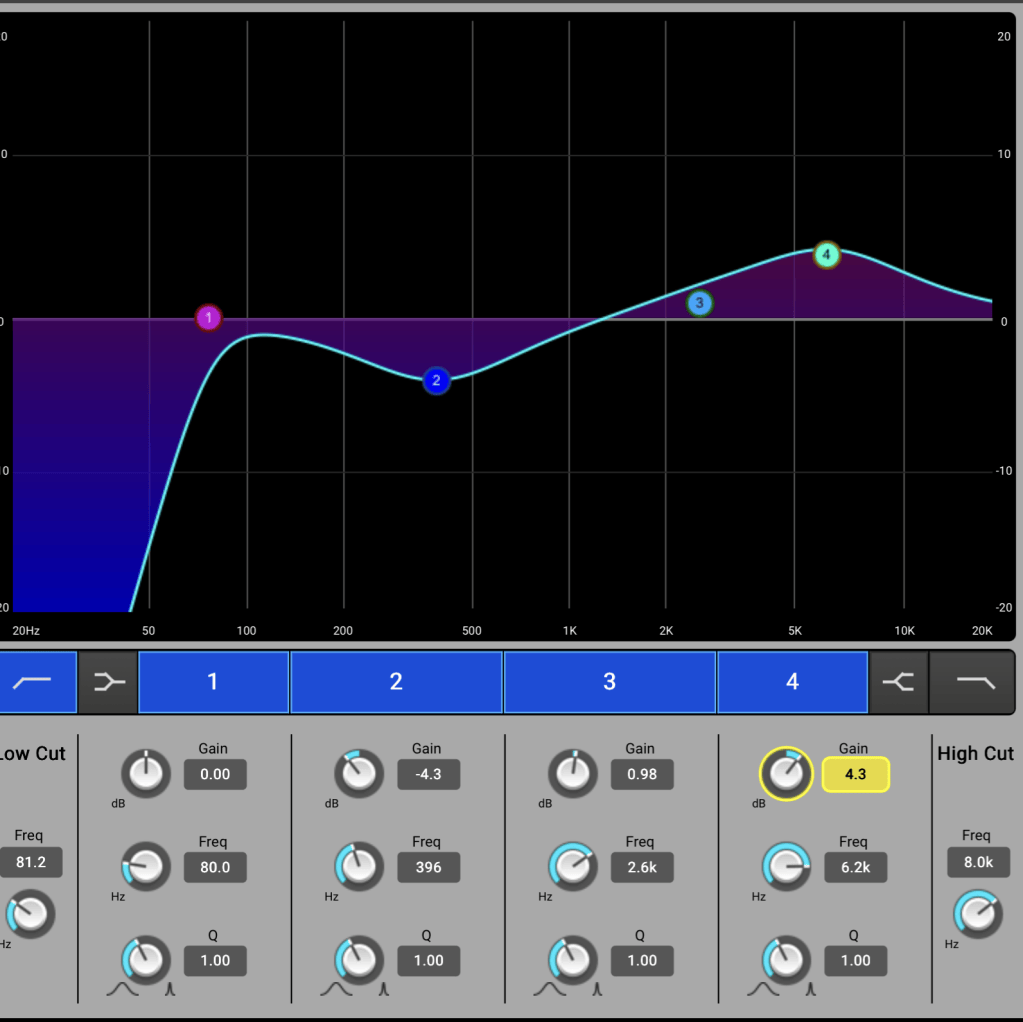
Guitar 4 was a nylon-string guitar, so right away I was working with a different tonal character. I wanted to preserve the warmth and softness of the nylon strings without letting the guitar become muddy or dull.
I kept the HPF around 81 Hz, then made a broad cut of about 4 dB around 400 Hz to clean up some low-mid muddiness. From there, I added just a touch around 2.6 kHz and a broader 4 dB boost around 6.2 kHz. That brought out more definition and articulation from the strings and helped the guitar sound clear without losing the warmer character that makes a nylon-string guitar distinctive.
Again, compare this curve to the guitars that came before it. Same stage. Same sound system. Same basic job—an acoustic guitar accompanying a singer. But this guitar needed me to take away some low mids and give it considerably more top-end presence.
That’s why I listen first and EQ second.
Guitar 5
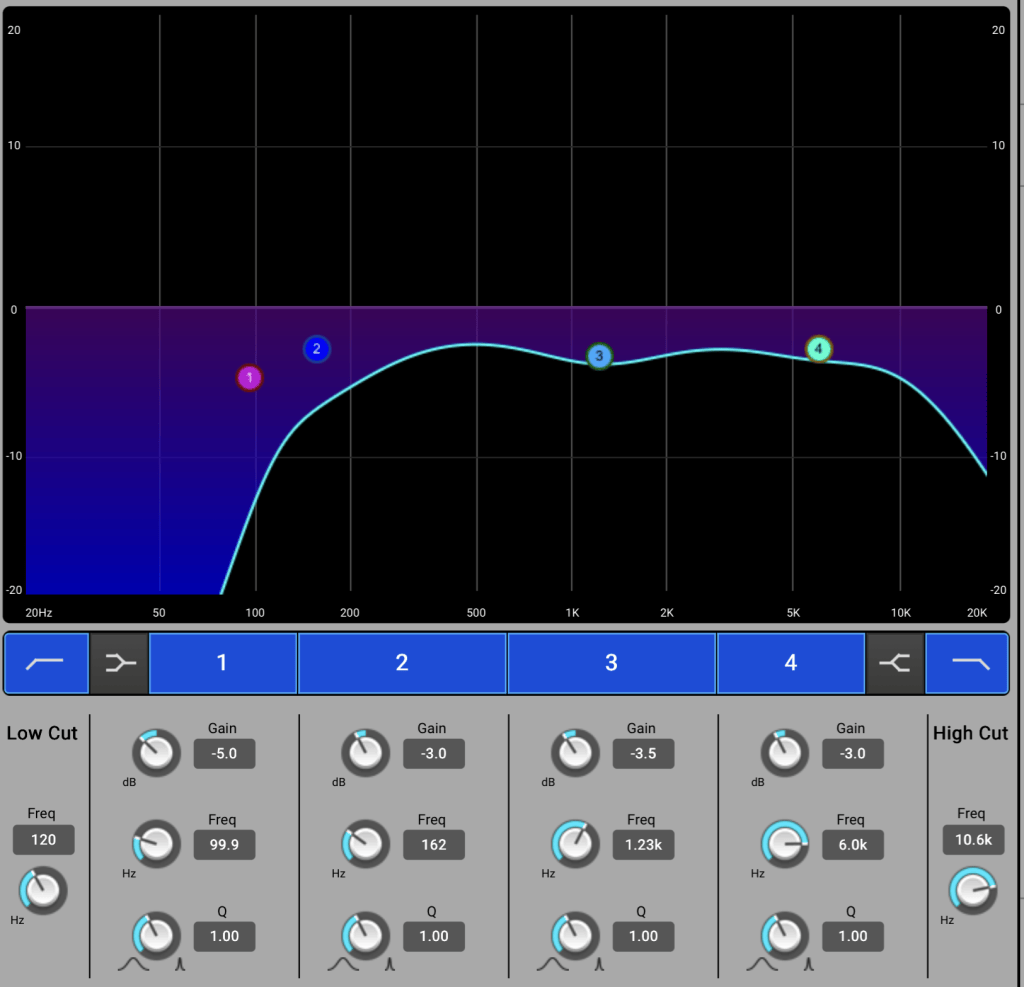
Guitar 5 added a completely different challenge: it didn’t have a pickup. I had to mic the guitar with an SM57, which meant I was no longer just EQing for tone. I also had to think about feedback and stability in the monitor.
Because the microphone was picking up the acoustic guitar in the room, it could also pick up sound coming back from the player’s wedge. That changed some of my EQ decisions. I moved the HPF considerably higher to about 120 Hz and made additional cuts around 160 Hz and 1.2 kHz to clean up the sound and help keep the channel stable.
This was also the one guitar where I engaged the low-pass filter (LPF), rolling off the upper frequencies above about 10.6 kHz. There wasn’t anything up there I needed from this guitar, so removing it helped me further control what the microphone was picking up without sacrificing the sound I wanted.
This guitar is a great reminder that EQ isn’t always just about making something sound better. In live sound, sometimes we’re balancing tone with stability. The best-sounding EQ curve in isolation isn’t very useful if the microphone wants to take off into feedback when the artist asks for more guitar in the monitor.
For a deeper look at what a low-pass filter does and why I use one, see my post, The Low-Pass Filter: With Strings Attached.
Five Guitars In, Five EQ Curves Out
By the time soundcheck was finished, I had worked my way down the line and EQ’d five acoustic guitars. Same stage. Same PA. Same basic role in the show. But take a look at those EQ curves—they’re nothing alike.
One guitar needed a little warmth added and some boxiness removed. Another had a troublesome low-frequency resonance that required a much more aggressive cut. Guitar 3 came in so muddy that most of my work was subtractive. The nylon-string guitar needed low-mid cleanup but benefited from additional presence on top. And then Guitar 5 changed the game completely because it didn’t have a pickup. Once I put a microphone in front of it, I wasn’t just EQing for tone anymore—I was also EQing for stability in the monitor.
And that’s really the beauty of the parametric EQ. Frequency, gain and Q give me the flexibility to listen to what’s actually coming into the console and respond to it. Frequency lets me choose where I want to work. Gain determines how much I want to boost or cut. And Q determines how wide or narrow an area I want to affect.
Sometimes I boost. Sometimes I cut. Sometimes the move is broad and gentle. Other times I’m targeting a very specific problem. And sometimes I leave a band completely untouched because the guitar simply doesn’t need it.
That’s why I don’t believe in blindly applying an “acoustic guitar EQ.” A starting point can be useful, but it’s only a starting point.
You don’t EQ an acoustic guitar. You EQ this acoustic guitar.
And on JAX Songstage, I might have to do that five times before the first song even begins.




 Soundcheck Diaries
Leave a comment