
There are some problems in live sound that seem mysterious until you understand what’s actually happening electrically.
This is one of them.
Recently at Campus JAX, a high-energy ’80s dance band came through with a Roland V-Drum kit. During soundcheck, we plugged the drummer’s outputs into our stage snake—and immediately heard it.
Hum.
Not just a little noise. A solid 60-cycle hum coming through every channel coming from the drum module.
The drummer wasn’t surprised.
“We have this problem at some venues,” he told me. “Other places it’s perfectly quiet.”
That statement alone was the clue.
The Setup
The drummer was sending four outputs from his electronic drum module.
His cabling looked like this:
Drum Module → 1/4-inch to XLR cable → Stage Snake → Mixer
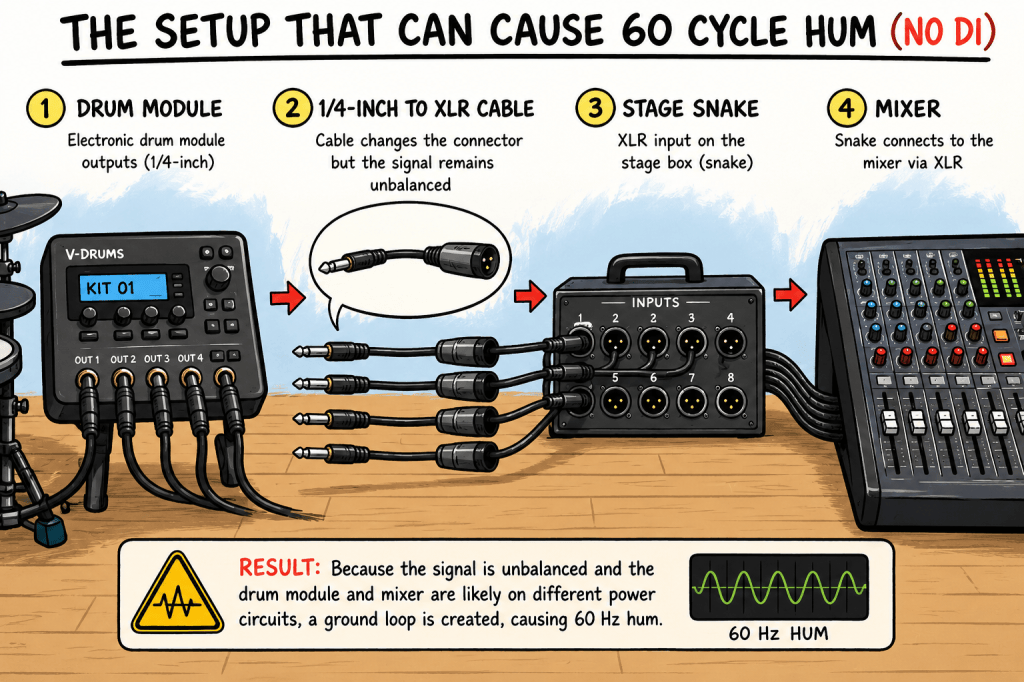
At first glance, nothing looked wrong. After all, the signal ended with an XLR connector.
But here’s the important lesson:
An XLR connector does not automatically mean the signal is balanced.
That’s one of the biggest misconceptions in live audio.
The Connector Wasn’t the Problem
Many musicians assume that if one end of the cable has an XLR connector, they’re sending a balanced signal.
Not necessarily.
A simple 1/4-inch-to-XLR cable is often nothing more than an adapter. It changes the connector—it doesn’t change the electrical characteristics of the signal.
The drum module was still sending an unbalanced signal.
That meant it was far more susceptible to noise and, in this case, a classic ground loop.
Why It Happened at Campus JAX
Electronic drum modules require AC power.
Our audio system also has its own AC power.
When equipment is plugged into different electrical circuits, each circuit can have a slightly different ground potential.
Those tiny voltage differences normally aren’t noticeable—until an audio cable connects the two systems together.
Now you’ve created a ground loop.
Instead of carrying only audio, the cable also becomes a path for unwanted current to flow between the two grounds.
The result is the unmistakable sound every live engineer knows:
60-cycle hum.

At Campus JAX, that’s exactly what happened.
Why It Didn’t Happen the Next Day
The following day, I mixed the same band at a summer concert in San Clemente.
Same drummer.
Same drum module.
Same cables.
No hum.
What changed?
Everything was powered from the same electrical distribution.
Because both systems shared the same ground reference, there was no voltage difference creating a ground loop.
The problem wasn’t the drum module.
It wasn’t the snake.
It wasn’t even the cable itself.
It was the combination of an unbalanced connection and different electrical grounds.
The Fix
Instead of plugging the drummer’s cables directly into the snake, we inserted DI boxes.
The signal path became:
Drum Module → 1/4-inch cable → DI Box → XLR → Snake → Mixer
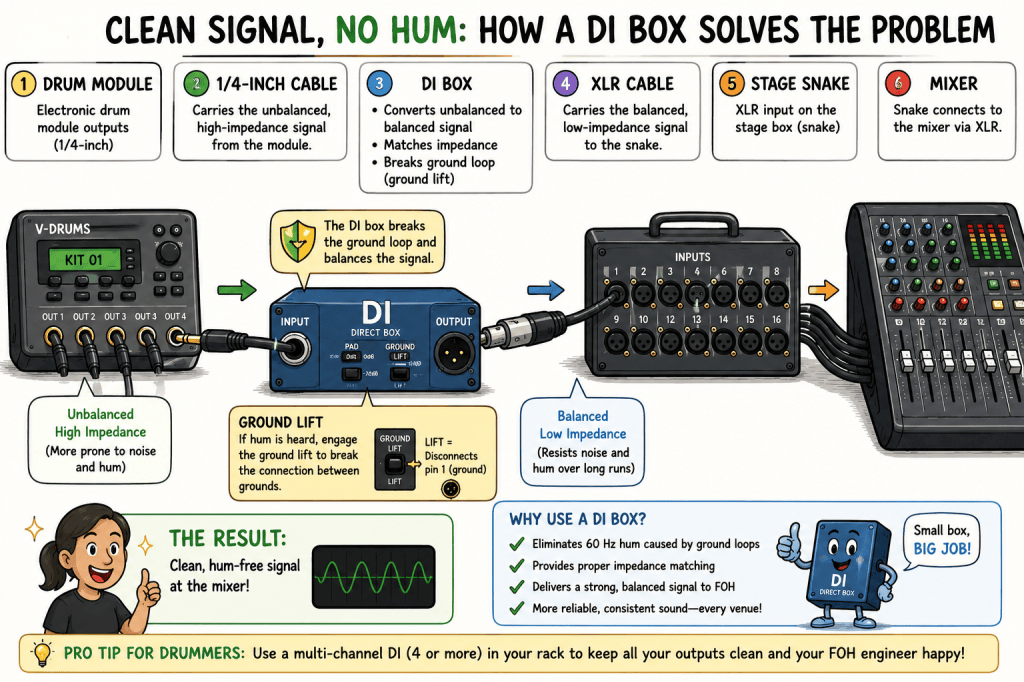
The hum disappeared immediately.
Why?
Because a DI box does far more than change connectors.
What a DI Box Actually Does
A quality DI box performs several important jobs at once.
1. It Converts the Signal
Most electronic instruments output a high-impedance or line-level signal on a 1/4-inch connector.
Mixers are designed to receive low-impedance balanced microphone signals over XLR.
A DI converts the signal into the format the console expects.
2. It Creates a Balanced Output
Balanced audio sends the signal on two conductors with opposite polarity.
Any electrical noise picked up along the cable appears equally on both conductors.
When the mixer’s preamp recombines the signal, that common noise is canceled, leaving the audio intact.
That’s why balanced lines can travel hundreds of feet with very little interference.
3. It Breaks Ground Loops
Many DI boxes contain an isolation transformer and a ground-lift switch.
The transformer passes the audio while preventing unwanted ground current from flowing between pieces of equipment.
In other words, it breaks the electrical path that creates the hum while still allowing the audio to pass cleanly.
That’s exactly what happened at Campus JAX.
Why Every Electronic Drummer Should Own One
If you regularly play electronic drums, keyboards, playback tracks, or modelers, a DI box isn’t optional—it’s insurance.
Most venues won’t have the same electrical system.
Some will be perfectly quiet.
Others will expose every weakness in your setup.
Adding a multi-channel DI to your rack means your outputs will always arrive at front of house as balanced, isolated signals, regardless of the venue.
The result is:
- Less hum
- Less troubleshooting
- Faster soundchecks
- Happier engineers
- Better shows

A Lesson Worth Remembering
One of my favorite things about live sound is that the same setup can work perfectly one day and fail miserably the next.
That doesn’t mean the gear is broken.
It usually means the environment changed.
Understanding why something happens is what separates replacing random equipment from solving the real problem.
In this case, the fix wasn’t buying new cables.
It was understanding that a cable with an XLR connector isn’t the same thing as a balanced output.
The DI box wasn’t just adapting connectors.
It was converting the signal, balancing the line, and isolating the grounds.
Sometimes the smallest box on stage is the one doing the biggest job.
And that’s exactly why, before this band plays another show, my recommendation to the drummer is simple:
Add a four-channel DI box to your rack.
Your front-of-house engineer will thank you.



 Soundcheck Diaries
Leave a comment