
I was beside myself with excitement when I learned that I would get to mix David Benoit. I grew up listening to his music—my dad played his albums constantly in our house. Two of my personal favorites were his rendition of Linus and Lucy and the beautiful Kei’s Song. Getting the opportunity to mix an artist whose music shaped my early listening experiences was truly special.

About David Benoit
David Benoit is one of the most influential contemporary jazz pianists and composers of the last several decades. A Grammy-nominated artist, conductor, and musical director, he has been a major force in shaping the smooth jazz genre. Over the years, he has worked with an impressive list of artists including Dave Koz, Rippingtons founder Russ Freeman, Brian McKnight, Kenny Loggins, and even collaborated on projects connected to Peanuts creator Charles Schulz, further cementing his association with the beloved Linus and Lucy theme.
The Challenge: Reinforcing an Acoustic Piano on a Loud Stage
David’s rider included an acoustic grand piano, which we had to rent to accommodate his performance. He would be playing with the lid on short stick. On our small stage—packed with a full band and horn section—I needed a solution that would keep the piano sounding natural and beautiful, yet loud enough to sit properly in the mix.
Equally important, I needed enough gain in the monitors so the band could reference the piano clearly. Anyone who has worked with grand piano in a loud environment knows how challenging that can be.
Grand pianos are most often miked with condenser microphones. The results can sound incredibly natural and detailed. However, in a live band setting, these microphones can struggle with gain before feedback, especially in monitors, and they are very susceptible to bleed from nearby instruments.
My Solution: Condenser Mics + Helpinstill
So here was my solution: I combined condenser microphones with a Helpinstill system.
Some of you may be wondering—what’s a Helpinstill?
The Helpinstill Piano Pickup is an electro-magnetic pickup system that mounts directly inside a grand piano. It uses three pickups placed across the string sets to capture vibration directly from the strings, similar to how an electric guitar pickup works. Because it senses string vibration rather than air movement, it provides excellent isolation, minimal bleed, and outstanding gain before feedback. It’s especially useful in loud stage environments, touring productions, and situations where stability is critical. The Helpinstill gained popularity with touring jazz and pop artists who needed consistent piano reinforcement night after night.
Installation and Routing
I use my Helpinstill anytime I have to work with an acoustic grand piano in a loud sound environment.
For David Benoit’s show I carefully installed my Helpinstill, making sure each pickup covered its area of strings evenly and maintained consistent distance. I also ensured the pickups did not overlap.
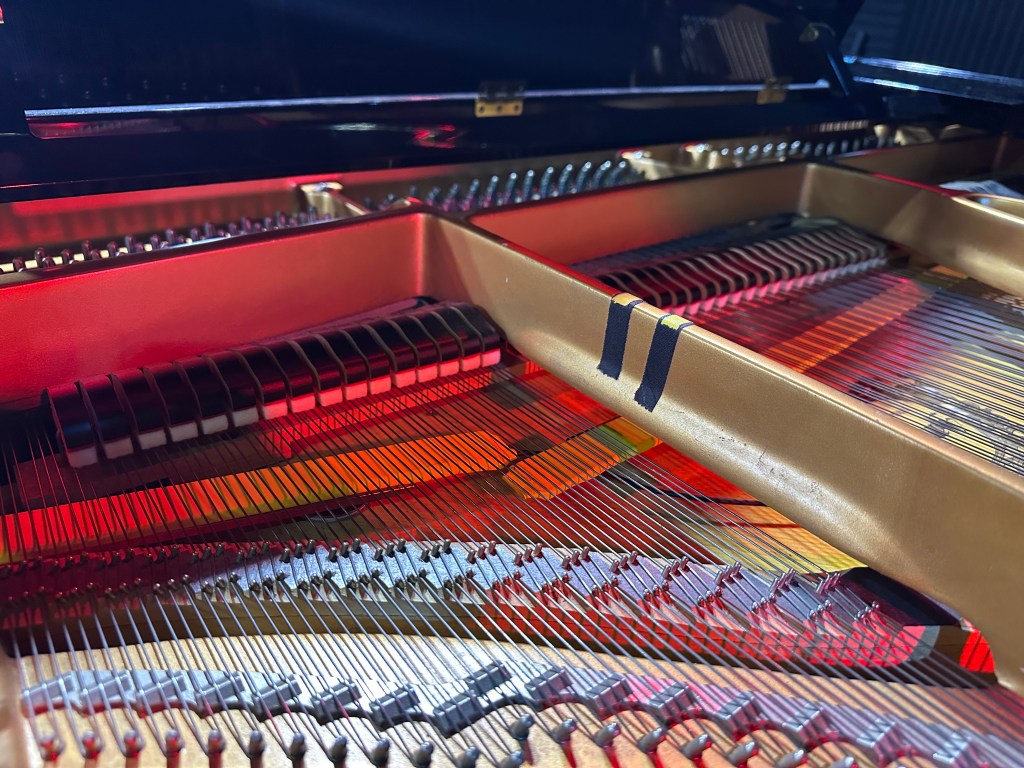
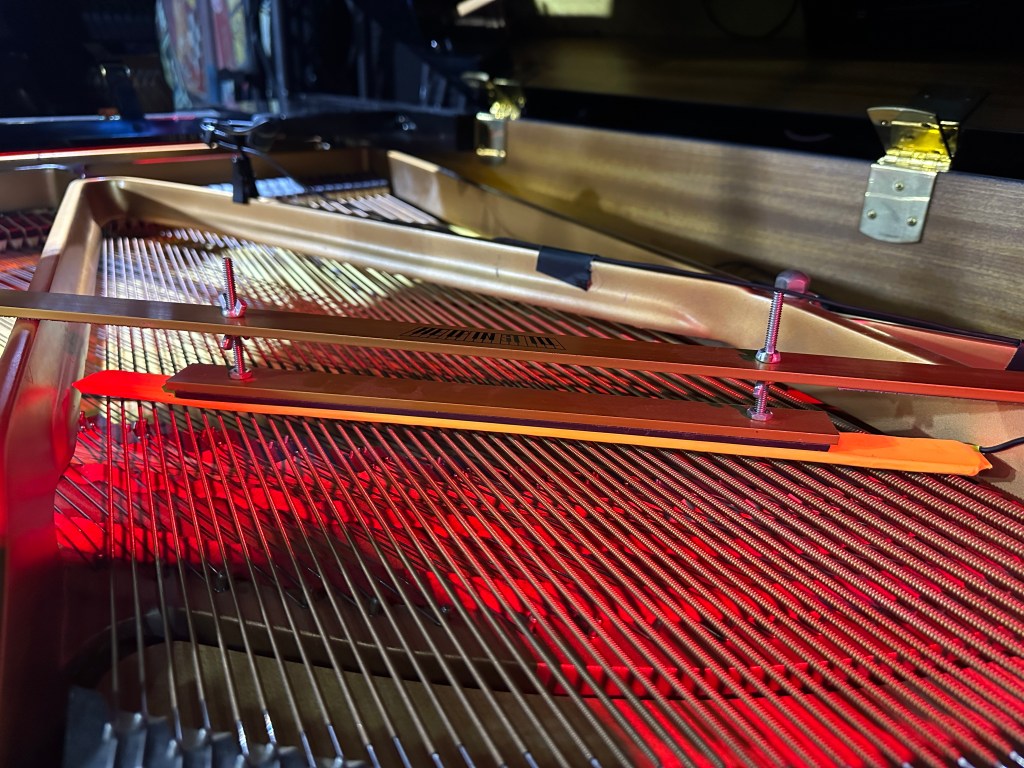
Helpinstill provides a summing box for all three pickups, but I chose to run each pickup into a small mixer so I could individually control gain. This allowed me to balance the output of each pickup and ensure even coverage across the piano. I then sent a mono output from that mixer into my snake. I learned how to install a Helpinstill by watching this video.
At the FOH console, I EQ’d the signal to even out the frequency response. Since a Helpinstill by itself can sound somewhat dry, I added just enough reverb to recreate the natural resonance you would hear from the piano’s soundboard.
Preparing the Condenser Mics
For the condenser microphones, I used Audio-Technica Pro 35s. They weren’t my first choice for piano miking, but they were what we had available. I created a stereo subgroup and used a 6-band PEQ to ring out a few offending frequencies. Then I shaped the tone of the high and low microphones using the channel PEQs and panned them 50% left and right in the house mix.
Blending the Two Sources
Here’s where the magic happens. The microphones provide the beautiful, natural tone of the instrument. The Helpinstill provides stability, clarity, and the ability to push the piano when needed—both in the house and in the monitors.
Blended together, the result is a piano sound that is big, full, natural, and musical.
After the show, David Benoit commented on how big and wonderful the piano sounded. His manager and band were thrilled with how the night came together, and I heard similar feedback from audience members. Moments like that are incredibly rewarding as the goal is always to serve the artist and make the music translate beautifully for everyone listening.


Applications for Churches and Worship Environments
Many houses of worship continue to keep grand pianos as a staple on stage, even as their musical style evolves to include louder, more modern bands. A Helpinstill can be an incredibly useful tool in these environments. It provides consistency, clarity, and control when the piano needs to coexist with electric guitars, drums, and modern instrumentation.
If your church audio team doesn’t yet have the trained ear to EQ a Helpinstill properly, I recommend having an experienced audio engineer create a preset. Once dialed in, it becomes a powerful and reliable solution.
Wrap-Up
Every stage presents its own set of challenges, and reinforcing an acoustic grand piano in a loud band setting is one of the trickier ones. By combining traditional condenser mics with a Helpinstill pickup, you can achieve both musicality and stability.
The goal is always the same: preserve the beauty of the instrument while ensuring it translates clearly to the audience and musicians. When the technology serves the music—and the artist feels inspired by what they hear—you know you’ve found the right solution.



 Soundcheck Diaries
Leave a comment