
How Panning Brought Darth Vader’s Theme to Life in a Broadcast Mix
I’m a total sci-fi nerd, so when Matt Johnson’s New Jet Set jazz band played their version of Darth Vader’s theme, I was absolutely captivated.
This band takes Disney classics and reimagines them in their own unique jazz style—and they are phenomenal. The arranger, Chris Barron (who also plays keys in the band), is incredibly gifted. He’s written tons of creative arrangements that breathe new life into songs we all know and love.
But in this particular performance, there was something else happening—something subtle, but incredibly powerful.
The magic of panning.
🎧 Listen First
Before I explain anything, take a listen to my live stream/broadcast mix.
👉 Headphones are highly recommended.
👉 If you’re on your phone, turn it horizontally so you can really hear the stereo imaging.
🎛️ What Is Panning (And Why It Matters)?
Panning is the process of placing a sound within the stereo field—left, center, or right.
In a live room, your ears naturally pick up where sounds are coming from on stage. But in a broadcast or live stream mix, that physical space disappears. The stereo field becomes your entire canvas.
That’s where panning becomes essential.
By spreading instruments across the stereo field:
- You create clarity so instruments don’t fight each other
- You add width, making the mix feel bigger and more immersive
- You allow the listener to follow the music more naturally
- And you reduce the need to constantly adjust faders because elements have their own space
In other words, panning helps you tell the story of the arrangement.
🎶 The Conversation Inside the Mix
In this arrangement of Darth Vader’s theme, Chris did something really cool.
The electric guitar and keyboards are essentially having a conversation. The melody line bounces back and forth between the two instruments—almost like a musical dialogue.
My job wasn’t just to make them loud enough…
It was to make that conversation clear and exciting for the listener.
So here’s what I did:
- 🎸 Electric Guitar → Panned 30% to the right
- 🎹 Keyboards (Stereo) →
- Left channel: 20% left
- Right channel: Hard right
By slightly tilting the keys to the right and placing the guitar nearby—but not on top of it—you can clearly hear the melody jump between the two.
The result?
I didn’t have to chase those parts with faders.
The stereo field did the work for me.
🥁 The Rest of the Stage
Here’s how the rest of the band was placed in the stereo field:
- 🎻 Upright Bass → Center
- 🥁 Kick Drum → Center
- 🥁 Snare → Center
- 🥁 Overheads → Hard Left / Hard Right
- 🥁 Hi-Hat → 40% Right
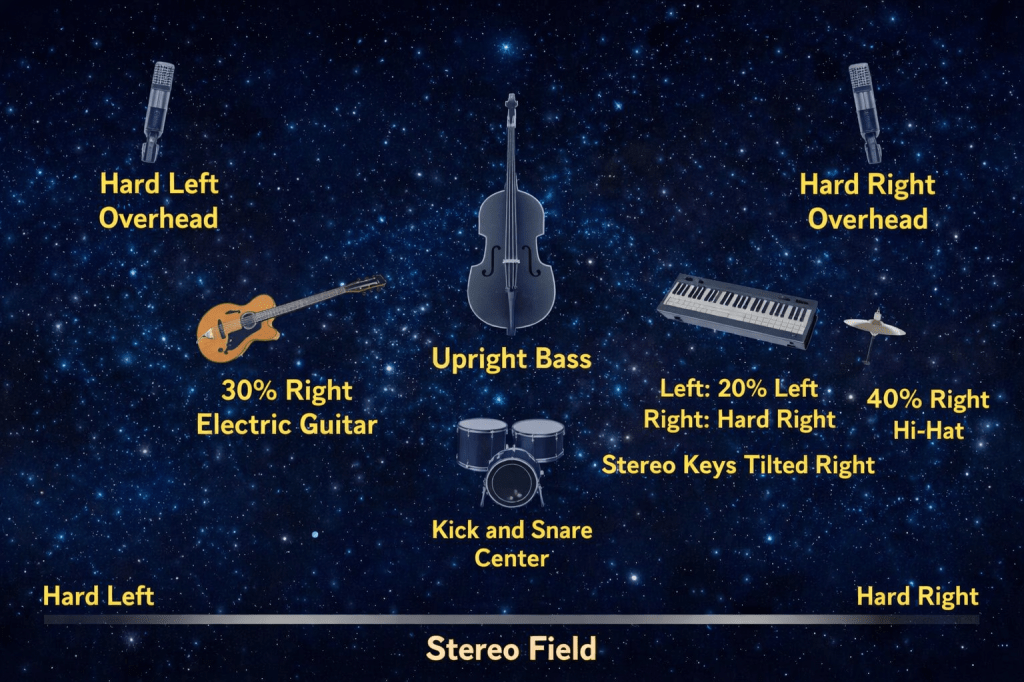
This keeps the foundation of the mix grounded in the center while allowing the cymbals and higher-frequency elements to add width and movement.
✨ Go Back and Listen Again
Now that you know what’s happening, go back and listen one more time.
Pay attention to how the melody moves.
Listen for the space between the instruments.
Notice how the mix feels wide, but still focused.
That’s the magic of panning.
It’s not just about left and right—it’s about creating space, telling a story, and bringing the arrangement to life.
Where the Stereo Field Meets Ministry
Houses of worship are running live streams every Sunday and during their various meetings throughout the week. This concept of panning is incredibly important so that the online listener can clearly hear everything that’s happening in the worship music.
I’ll be diving deeper into this in future posts, but for now, start thinking of your stereo field as more than just left and right—it’s a tool to bring clarity, space, and intention to your mix, no matter where your audience is listening from.


 Soundcheck Diaries
Leave a comment